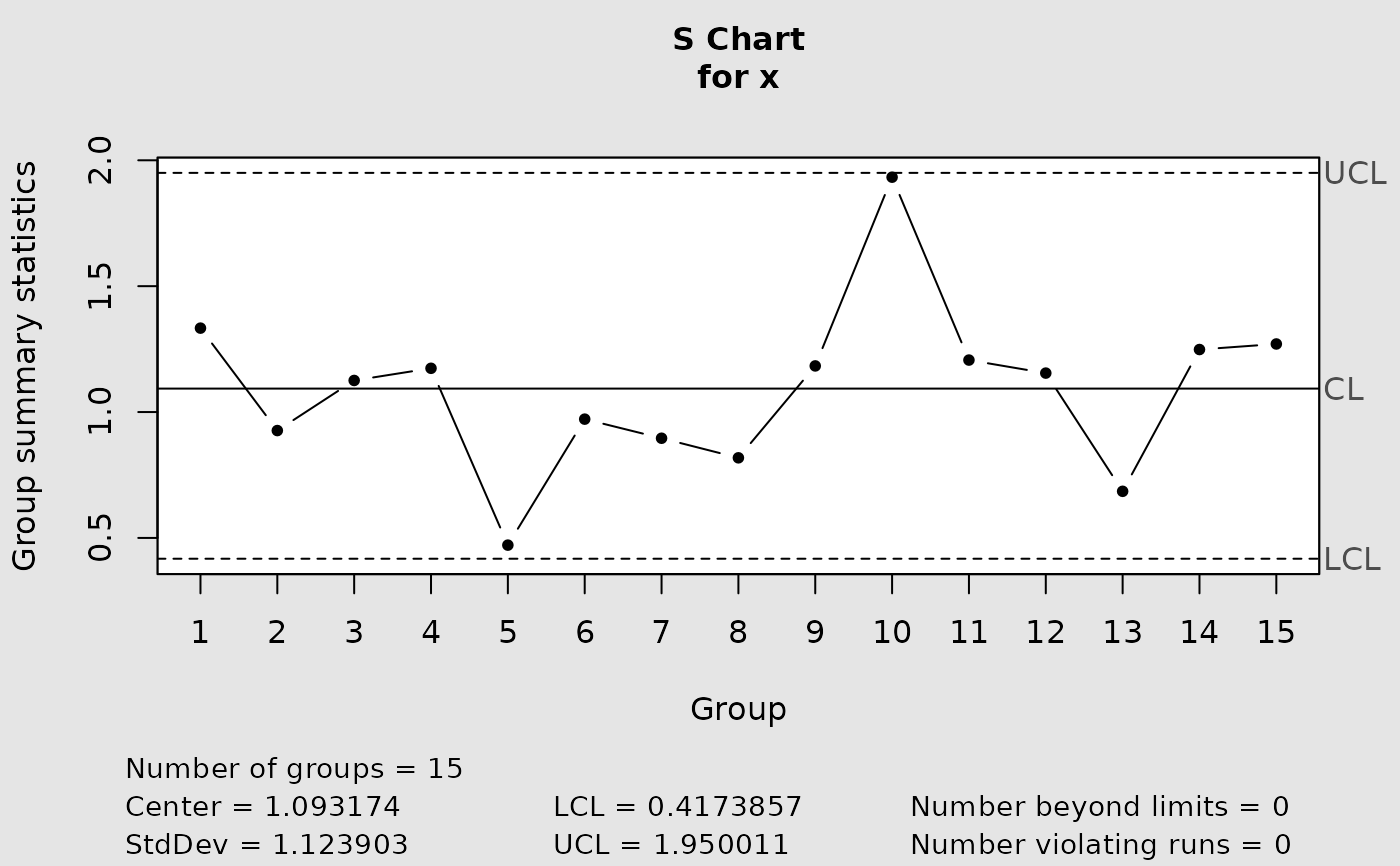
Build a control chart for subgroup standard deviations using either the
conventional Shewhart limits used historically by qcc or exact
probability limits derived from the chi-square distribution of the sample
variance. Numerical limits are delegated to s_shewhart_limits
and s_exact_limits.
Usage
cchart.S(x, type = c("n", "e"), m = NULL)Arguments
- x
Subgroup data accepted by
qcc::qcc()for an"S"chart. Rows represent subgroups and columns observations within subgroups.- type
Either
"n"for the normalized qcc-compatible limits or"e"for exact equal-tail probability limits.- m
Integer subgroup size, at least 2. It is required when
type = "e". If omitted, a warning is issued and the normalized chart is drawn instead. This argument is retained unchanged for compatibility with historical positional calls.
Value
Invisibly, the "qcc" object returned by qcc::qcc().
The function also draws the chart.
Details
For exact limits, \((m-1)S^2/\sigma^2\) follows a chi-square distribution
with \(m-1\) degrees of freedom under normality. The historical wrapper
estimates \(\sigma\) from x using qcc::sd.S() and supplies
that estimate to s_exact_limits(); these are therefore plug-in
probability limits.
For type = "n", the legacy qcc convention is deliberately preserved:
the center is the weighted mean of the observed subgroup standard deviations,
while \(\sigma\) is estimated separately by qcc::sd.S(). The
resulting standard error is \(\hat\sigma\sqrt{1-c_4(n)^2}\). This differs
in finite Phase I samples from replacing the observed center by the
theoretical \(c_4(n)\hat\sigma\); cchart.S() does not make that
replacement.
Phase convention
The existing API has no separate Phase I argument. Both the chart center and
\(\sigma\) estimate are obtained from x; exact limits additionally
use the supplied historical design size m. Thus both normalized and
exact limits are plug-in limits when used through this wrapper.
Errors and warnings
An error is raised for an unsupported type or an invalid supplied
m. If exact limits are requested without m, the function
warns and falls back to the normalized chart. Additional data validation is
performed by qcc::qcc(), qcc::stats.S(), and
qcc::sd.S().
Examples
data(softdrink)
normalized <- cchart.S(softdrink, type = "n")
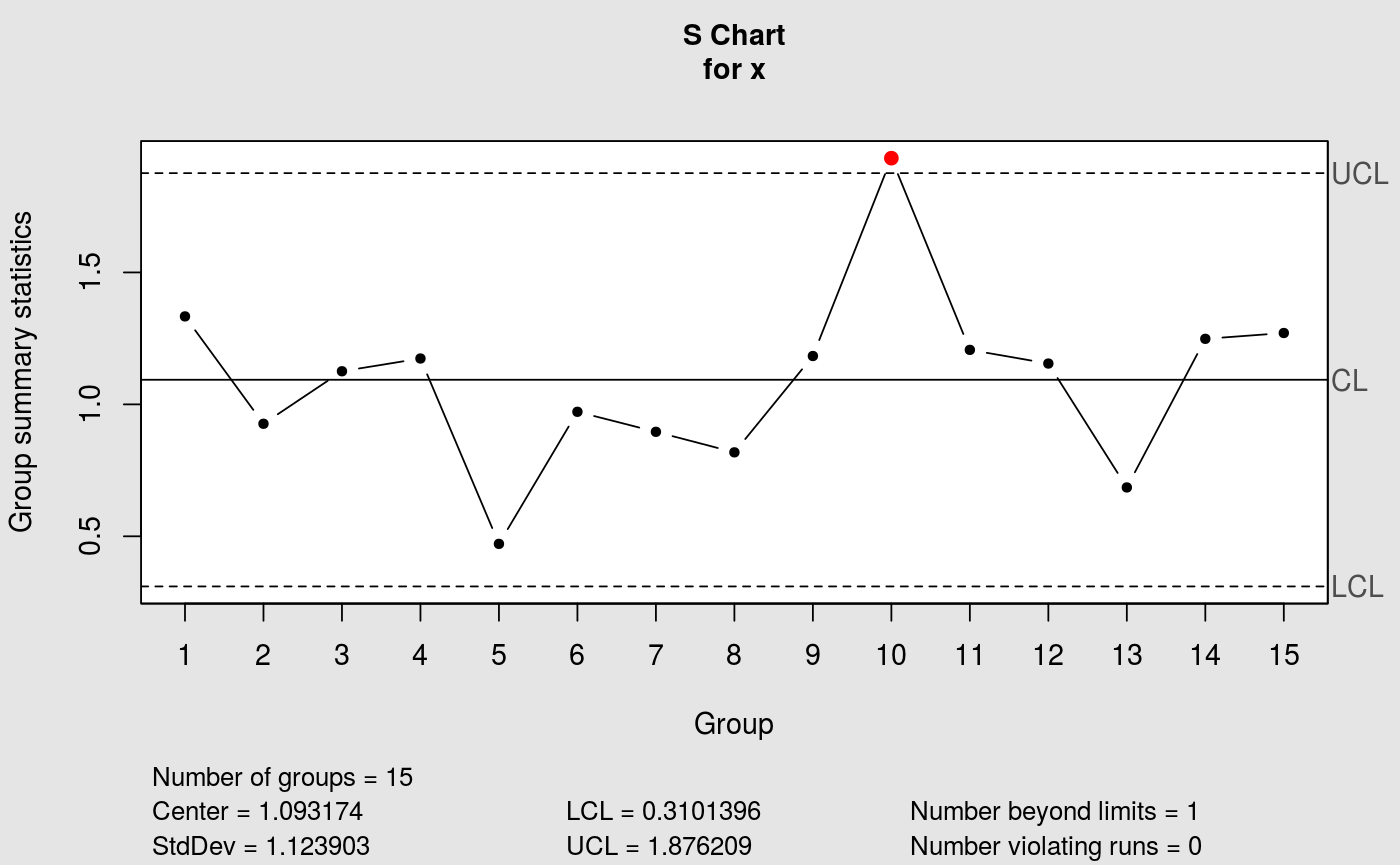 exact <- cchart.S(softdrink, type = "e", m = 10)